The Two Daily Exercise Routines That Helped Me Rebuild My Life after Pulmonary Fibrosis

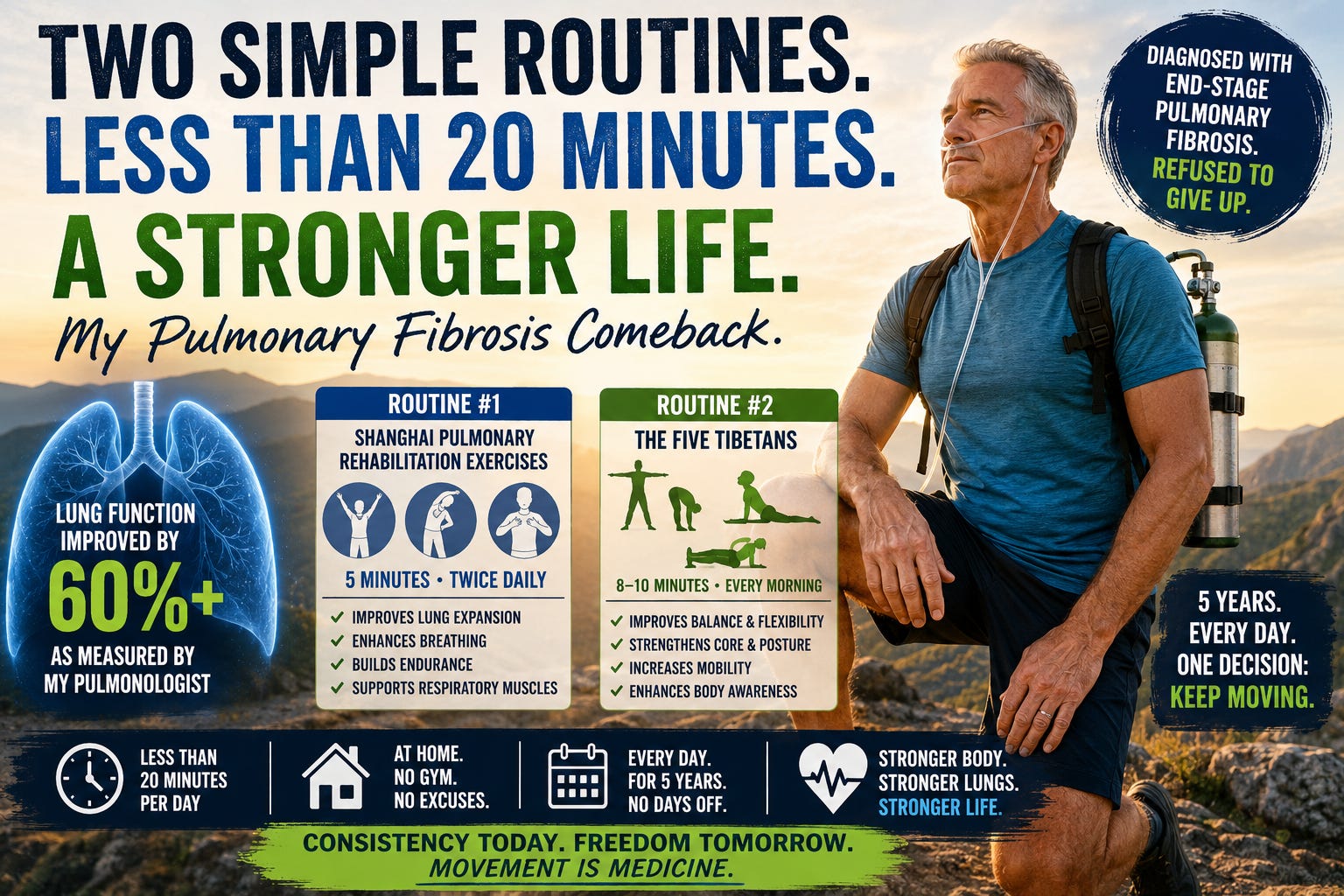
When people hear my story and see the active life I live now despite being diagnosed with advanced end-stage pulmonary fibrosis five years ago, many describe my recovery as “miraculous.”
I understand why they say that.
Years ago, after my diagnosis with pulmonary fibrosis, my future looked very different than it does today. Like many patients, I struggled with breathlessness, declining stamina, fear, uncertainty, depression and the emotional weight that comes with a chronic lung disease and greatly shortened life expectancy.
But I do not believe my improvement has been miraculous.
I believe it was built one day at a time through discipline, perseverance, movement, exercise and consistency.
For nearly five years now, I have followed two very simple exercise routines every single day. EVERY SINGLE DAY! Together, they require less than 20 minutes per day, can be done at home, require no gym membership, and yet have profoundly changed my strength, flexibility, breathing mechanics, endurance, and overall quality of life. These exercises are the core foundation daily habits I have that have improved my lung function as measured by a pulmonologist by well over 60% and improved my physical strength, cardiovascular fitness and overall physical health significantly. I am back to the level of strength from 20 years ago when I used to race 140 mile Ironman triathlons, with one difference, due to lung scarring I wear an oxygen tank when I exercise.
The exercises did not “cure” pulmonary fibrosis. But they helped me reclaim my body, improve my lung expansion, strengthen my muscles, increase my exercise capacity, and build the foundation that has allowed me to perform more intense, difficult exercises safely over time.
Routine #1: The Shanghai Pulmonary Rehabilitation Exercises
The first routine comes from a pulmonary rehabilitation protocol developed for pulmonary fibrosis patients and studied by physicians at the Shanghai Pulmonary Hospital
The protocol consists of three simple breathing and movement exercises that take approximately five minutes to complete. I perform them twice daily and have done so consistently for nearly five years.
The exercises are described in this published pulmonary rehabilitation study:
Shanghai Pulmonary Rehabilitation Study
What I appreciate most about this program is its simplicity. These are not exhausting workouts. They are targeted movements designed to improve:
Lung expansion
Chest wall mobility
Breathing coordination
Respiratory muscle engagement
Functional endurance
Pulmonary rehabilitation research has consistently shown that structured exercise programs can improve exercise tolerance, reduce shortness of breath, and improve quality of life in patients with chronic lung disease, including pulmonary fibrosis.
For me, these exercises became a daily investment in maintaining mobility and breathing function.
More importantly, they helped create momentum.
On difficult days, when motivation was low, I could still complete five minutes. That consistency mattered more than intensity.
Here’s a demonstration showing the Shanghai 3 exercises: https://youtu.be/xZPdDVp3KCE?is=PLCuDaj4JVip5qas
Routine #2: The Five Tibetans
The second routine I practice every morning is known as the “Five Tibetans,” a five-part movement sequence popularized in the book The Eye of Revelation. They are similar to some yoga exercises.
These exercises take about 8–10 minutes each morning and can easily be learned through instructional videos online. One of the clearest demonstrations I have found is here:
Five Tibetans Demonstration Video
Over time, I found they improved several things that pulmonary patients and aging folks often lose:
Balance
Flexibility
Core strength
Posture
Mobility
Body awareness
Many lung patients gradually become deconditioned. As breathing becomes harder, movement decreases. As movement decreases, muscles weaken. As muscles weaken, daily activities become even harder. It becomes a vicious cycle.
The Five Tibetans helped interrupt that cycle for me.
The exercises gently challenge the entire body while encouraging coordinated breathing and movement. I noticed improvements not only in flexibility and strength, but also in how open and expanded my chest felt during breathing.
Good posture and thoracic mobility matter more than many people realize. When the chest becomes stiff and posture collapses forward, breathing mechanics worsen. Daily mobility work can help maintain better chest expansion and physical function.
Small Daily Habits Create Big Long-Term Results
The greatest lesson I have learned is this:
Small actions performed consistently over years can produce extraordinary results.
Many people want a quick fix:
a new medication
a supplement
a miracle therapy
a shortcut
But the human body changes through repetition.
Most of the patients I have counseled over the years begin enthusiastically but stop when results are not immediate. The truth is that meaningful physical adaptation often happens slowly and quietly.
Five minutes today may not seem important.
But five minutes every day for five years becomes transformational.
Exercise Became the Gateway to Recovery
These short daily routines are not my only exercise.
Instead, they became the foundation that allowed me to do more.
Because I maintained flexibility, mobility, respiratory muscle engagement, and baseline conditioning, I was able to gradually perform:
strength training
higher intensity cardiovascular exercise
walking programs
interval training
pulmonary fitness workouts
hiking
Various other sports
Over time, my endurance improved dramatically. My strength improved. My confidence improved.
Perhaps most importantly, my fear diminished.
What I Tell Other Patients
I never tell patients that everyone will experience the same outcome I have.
Every pulmonary fibrosis journey is different.
But I do tell them this:
The body responds to movement.
Even damaged lungs benefit from a stronger cardiovascular system, stronger muscles, better posture, improved circulation, and enhanced breathing efficiency.
You do not need to begin with an hour-long workout.
You begin with consistency.
Five minutes.
Ten minutes.
Every day.
The goal is not perfection.
The goal is momentum.
And sometimes momentum changes lives.
As with any exercise program, patients with pulmonary fibrosis or other chronic medical conditions should consult their physician before beginning a new routine, especially if supplemental oxygen or cardiovascular limitations are involved.
Thanks Lee, your information has increased my ability and helped remove the depression i was falling into. Everyone who asks how I'm doing it i say Lee Fogle.
You are an inspiration 🙏