Moving the SOB Curve: How Exercise Redefines Shortness of Breath

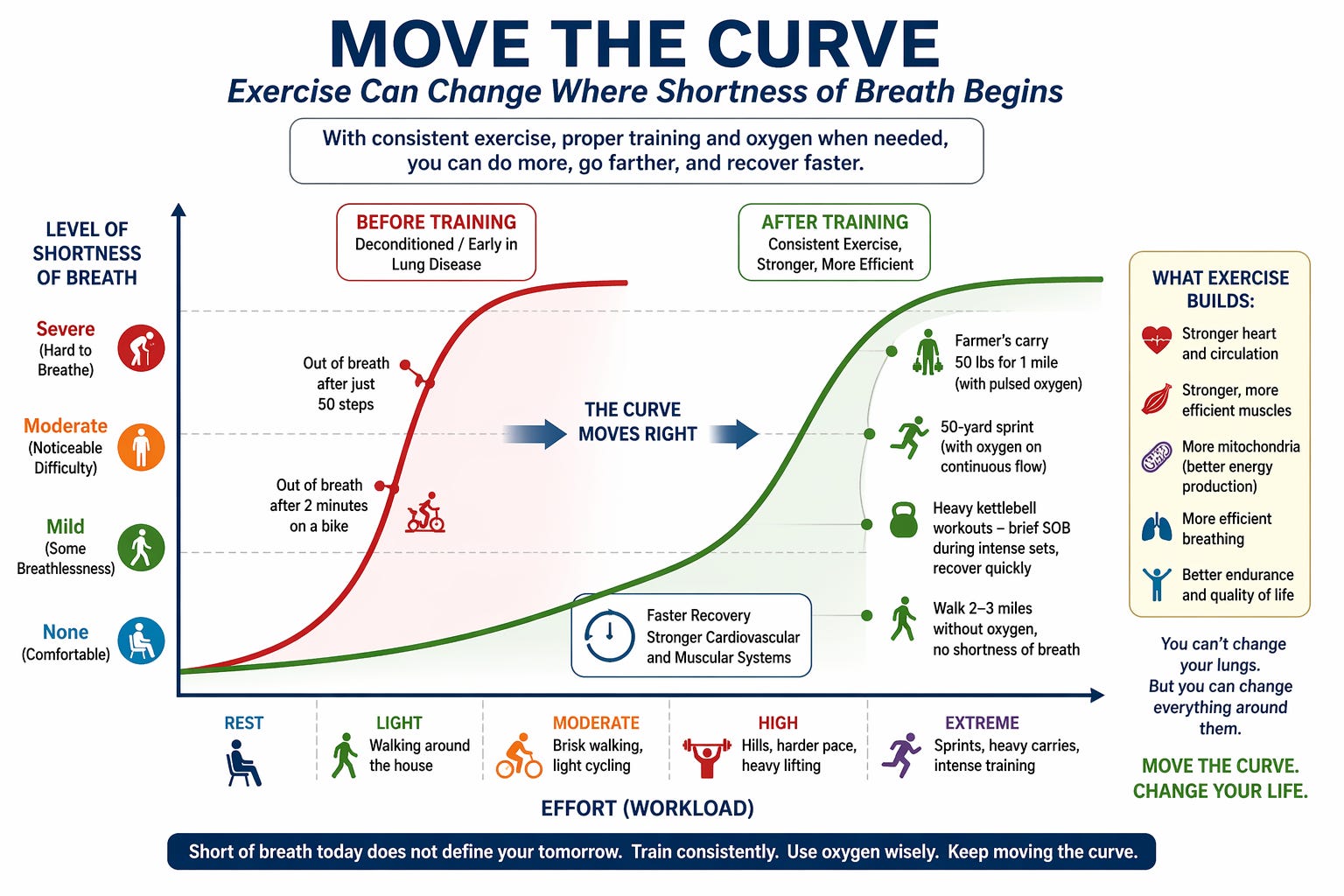
I often talk to patients in support groups who are worried and complaining that doing the slightest activities causes shortness of breath (SOB). They become hypervigilant over their oxygen saturation and to avoid the slightest feelings of SOB they become more and more sedentary. That’s the exact opposite of what can help them.
I’ve seen many people, including myself, improve from extreme shortness of breath at the slightest exertion and become able to do far more while living much more active lives by learning to do one thing: Move the SOB curve. Here’s how that has worked for me and many more patients with impaired lungs.
When you live with lung disease, shortness of breath can feel like a fixed limit.
A wall you hit… sooner than you used to.
But that “wall” is not fixed and immovable and for many patients—it moves.
The Curve You Don’t See (But Feel Every Day)
Imagine a curve:
On the bottom axis: effort (walking, climbing, lifting)
On the side axis: shortness of breath
At the beginning of lung disease—there is often a physical, cardiovascular and muscular deconditioning that occurs as patients become more sedentary, often depressed and physically weaker — and the SOB curve rises very quickly.
50 steps → breathless
2 minutes on a stationary bike → breathless & exhausted
That’s not just lung limitation.
That’s also deconditioning layered on top of lung disease.
Research in pulmonary rehab shows that inactivity leads to:
Reduced muscle efficiency
Earlier lactic acid buildup
Increased breathing demand for the same task
(Source: American Thoracic Society pulmonary rehabilitation guidelines; Exercise Physiology)
⸻
What Exercise Actually Changes
With consistent training—especially when supported by supplemental oxygen as prescribed by a healthcare professional—you begin to shift that curve.
Not by fixing the lungs directly, but by improving everything around them:
Muscles become more oxygen-efficient
Mitochondria increase (better energy production)
Lactic acid production is delayed
Heart and circulation improve oxygen delivery
Breathing becomes more coordinated and efficient
This means:
👉 You can do more work before breathlessness begins
👉 And when breathlessness does come, you can recover faster!
This is well established in pulmonary rehab literature, including findings summarized by the Pulmonary Fibrosis Foundation and clinical programs modeled after American College of Sports Medicine exercise guidelines.
⸻
My SOB Curve: Then vs Now
Five years ago:
50 steps → extreme short of breath & heart rate of 115 BPM
2 minutes cycling → extreme SOB and exhaustion
Severe limitation even with oxygen support
Today:
Farmer’s carry: 50 lbs carried in hands for a mile with oxygen
50-yard sprint with oxygen
Heavy kettlebell training w/ oxygen
Standup paddle boarding 3-4 miles in the ocean w/ oxygen
Walk daily 2–3 miles WITHOUT oxygen, no breathlessness, and heart rate of 82 BPM (30% improvement)
Same lungs.
Different system.
That’s the curve moving.
⸻
The Critical Role of Oxygen
One of the biggest misunderstandings is this:
“If I need oxygen, I should take it easy.”
In reality, properly used supplemental oxygen can allow you to:
Train at higher intensities safely
Prevent dangerous desaturation
Build conditioning that would otherwise be impossible
Folks who know me or watch my exercise videos on YouTube know that I often say that my oxygen tank is my superpower!
This aligns with clinical recommendations from organizations like the American Lung Association, which emphasize oxygen use to enable activity, not restrict it.
⸻
The Goal Is Not “No Breathlessness”
This is important.
You are not trying to eliminate shortness of breath.
You are trying to earn it at a higher level.
Before: breathless tying your shoes or walking to the restroom
After: breathless during intense exercise
That’s a completely different life.
⸻
A Simple Way to Think About It
Instead of asking:
“How do I avoid shortness of breath?”
Ask:
“How do I push the point where it begins farther out?”
That is the entire game.
But remember, this is not just two 30 minute sessions a week in Pulmonary Rehab. This is daily activities, where you use supplemental oxygen to push yourself harder to do progressively harder things that make you stronger. As we age, it is vitally important that we maintain skeletal muscle for balance and metabolic health. It is a guarantee that you will lose skeletal muscle through extreme inactivity. Consistent exercise is vital to maintain overall health and to move the SOB curve.
*** THIS IS NOT MEDICAL ADVICE. I AM A PATIENT, NOT A DOCTOR. CONSULT YOUR MEDICAL PROFESSIONAL PRIOR TO UNDERTAKING STRENUOUS EXERCISE.